
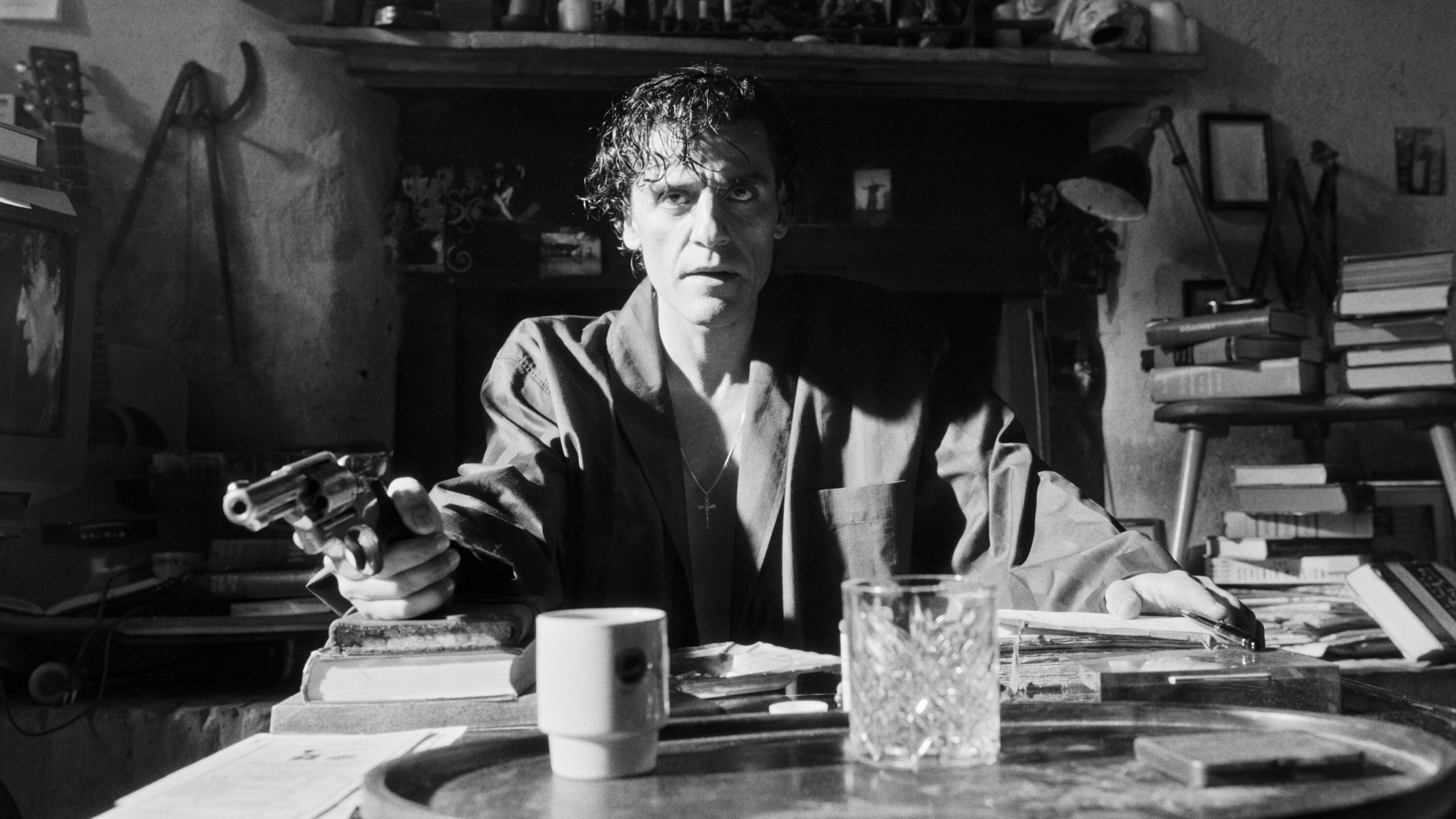

Dense, complicated, and ultimately fascinating, the latest film from artist and filmmaker Julian Schnabel (Basquiat, Before Night Falls, The Diving Bell and the Butterfly, At Eternity’s Gate), In the Hand of Dante, tells two parallel stories set roughly 600-700 years apart. Based on the 2002 novel by Nick Tosches and adapted by Schnabel and Louise Kugelberg, the film actually features Tosches as a character (played by Oscar Isaac) who is an expert on Dante Alighieri’s The Divine Comedy, of which there has never been an original copy in the world. In scenes shot in black-and-white and set in the very early 2000s, Tosches is recruited by a mob boss (John Malkovich) who claims to have an actual copy of the manuscript in Dante’s own handwriting from the 14th century and he wants the author to verify it so that he can sell it for an unfathomable price.
The second story involves Dante himself (also played by Isaac, in scenes shot in vibrant color) in Italy, showing his struggle writing the epic poem and looking for both inspiration and knowledge in order to do so effectively. He seeks assistance from many sources, including his longtime mentor, Isaiah (Martin Scorsese), his wife Gemma (Gal Gadot, who also appears in the modern segments as Tosches’ love interest Giulietta), and even the church, represented by Pope Boniface VIII (Gerard Butler, also playing the mobster’s absolutely filterless button man, Louie, in the present day). As beautifully shot and composed as the scenes in Italy are, they aren’t nearly as interesting or compelling as the stuff set in the 2000s, which are violent, unpredictable, and often quite funny, especially Butler’s blonde-haired Louie, who speaks his full mind in every situation and gives me hope that the rest of Butler’s career won’t be devoted to second-tier action films.
The film also features Jason Mamoa as a mysterious representative of a group trying very hard to retrieve the manuscript, and honestly his scenes are so ineffective, they could have been excised and you’d never miss them. That can actually be said for a few sequences and performances in this movie, which runs slightly longer than two-and-a-half hours. Although the character is important to the story, Gadot doesn’t really add much to either timeline and is miscast to the detriment of the work. Other elements of In the Hand of Dante I could have watched for longer, including the actual authentication process, which is fascinating and takes us to unexpected places. There’s also an opening sequence featuring Tosches as a child being taught a morality lesson by his Uncle Carmine (a beautifully understated Al Pacino); it’s a scene that sets the tone for the entire piece and could easily have been turned into a lovely short film. And if you don’t blink, you might catch a great cameo by the legendary Franco Nero as well.
In the Hand of Dante is a film about obsession, inspiration, beauty, and how all of these things contribute to one’s understanding of the divine. It’s part crime thriller, part international mystery, part relationship drama, and it all braids together into a strange but ultimately satisfying story that illustrates that some things throughout the centuries never change and some have changed forever and sadly will never go back. I happen to think Schnabel is a masterful filmmaker, and despite a few bizarre choices (or maybe because of them), In the Hand of Dante fits nicely into his filmography.
The film is now streaming on Netflix.
If you enjoyed this post, please consider supporting Third Coast Review’s arts and culture coverage by making a donation. Choose the amount that works best for you, and know it goes directly to support our writers and contributors.
